Thanks for Being My Teacher: An Embroidery Review
As a professional embroidery designer and product reviewer, I approach every new graphic with a specific question: will this actually stitch out cleanly on a finished product? When evaluating Thanks for Being My Teacher, I am looking beyond the screen preview to understand how the lines, spacing, and overall composition will translate into thread. This design falls squarely within the Crafts and Graphics categories, but its true value lies in its versatility for apparel decorators, Etsy sellers, and makers creating personalized gifts. The download package is robust, including 1 DXF file, 1 PDF file, 1 SVG file, 1 PNG file (300ppi with transparent background), 1 JPG file, and 1 EPS file. While these formats are excellent for digital mockups and cutting machines, embroidery professionals must remember that vector or raster graphics require digitizing before they can become a machine embroidery design.
First Impressions and Visual Personality
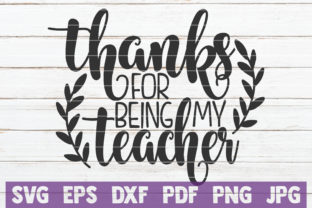
My initial assessment of Thanks for Being My Teacher reveals a sentiment that is warm, appreciative, and universally recognizable. The typography and layout suggest a balance between playful and respectful, making it suitable for various age groups from preschool educators to university professors. Visually, the design possesses enough negative space to prevent it from feeling heavy or bulletproof when stitched. For a handmade product, this visual breathing room is essential. It allows the fabric texture to show through, which adds to the artisanal quality of the finished piece. The shape feels organic rather than rigid, implying that it would work beautifully as a centered chest placement on a sweatshirt or as a standalone motif on a tote bag design. The mood is celebratory yet grounded, avoiding overly cutesy elements that might alienate recipients looking for a more mature aesthetic.
Real-World Application: The Custom Sweatshirt Test
To truly evaluate this asset, I mentally placed it in a real-life production scenario: creating custom crewneck sweatshirts for a school’s end-of-year staff appreciation event. In this context, Thanks for Being My Teacher needs to perform under commercial embroidery standards. Sweatshirt fleece is thick and has a slight stretch, which can distort designs if the stitch density is too high or the underlay is insufficient. Because this product is provided as a graphic, the digitizer has control over the outcome. I would recommend utilizing a combination of satin stitch for the lettering to ensure crisp edges against the fuzzy fleece, and perhaps a lighter fill stitch or running stitch for any decorative accents to maintain garment drape.
For this specific project, customer trust hinges on legibility. Teachers need to read the message clearly from a conversational distance. If I were selling this as a personalized gift on Etsy, I would ensure the text height remains above 6mm after digitizing to guarantee clarity. The design’s layout supports this well, as it appears to have a horizontal orientation that complements the wide expanse of a sweatshirt front without requiring excessive hoop size adjustments. This makes it an efficient choice for small shop products where turnaround time and material costs matter.
Navigating Fabric Challenges and Technical Limits
While the design is versatile, certain applications require caution. When considering Thanks for Being My Teacher for items like baby embroidery onesies or lightweight tea towels, the stabilizer choice becomes critical. Thin fabrics cannot support dense stitch counts without puckering. If you adapt this graphic for delicate materials, consider converting solid areas to running stitches or redwork styles to reduce tension. Conversely, when working with textured fabrics like terry cloth for kitchen towels, you may need to increase stitch width or add a topping to prevent the design from sinking into the pile.
Caps and curved surfaces present another challenge. The natural arc of a hat brim can distort straight text lines. Before committing this design to headwear, verify that the aspect ratio works within your cap frame’s limitations. You may need to slightly adjust the curvature of the text during the digitizing phase to compensate for the distortion inherent in cap embroidery. Additionally, be mindful of tiny lettering or intricate corners. If the original graphic features very fine serifs or tight gaps, these may need to be simplified to prevent thread breaks or needle damage during high-speed stitching. Always inspect small details at 100% zoom in your embroidery software before sending the file to the machine.
Enhancing Product Value and Brand Consistency
Using high-quality design assets like Thanks for Being My Teacher directly impacts buyer engagement and perceived value. A clean, professional stitch-out signals competence to customers browsing your Etsy listings or craft fair booth. The included 300ppi PNG with transparent background is particularly valuable here. It allows you to create accurate printable mockups for your online store without having to stitch a sample first. This helps maintain brand consistency across your digital storefront while you prepare physical inventory. For creative entrepreneurs, the ability to show clients exactly what their custom apparel will look like builds confidence and reduces revision rounds.
Furthermore, the multi-format inclusion (DXF, SVG, EPS) means this graphic can serve dual purposes. You could use the SVG for vinyl decals on matching tumblers or the PNG for sublimation prints on mugs, creating a cohesive collection around the embroidery project. This cross-media potential increases the return on investment for small business owners who offer diverse product lines. However, always confirm licensing terms before selling finished items or digital derivatives to ensure your commercial embroidery activities remain compliant.
Essential Designer Notes for Success
Before loading Thanks for Being My Teacher into your production queue, adhere to these practical guidelines to ensure professional results:
- Test Stitch First: Never assume a digitized version will be perfect. Always run a test on scrap fabric that matches your final project’s weight and weave to check registration and tension.
- Verify Thread Colors: Check contrast ratios, especially on dark fabrics. White or cream thread usually offers the best readability for teacher appreciation themes, but test against your specific garment color.
- Assess Stitch Density: Ensure the digitized file does not exceed safe density limits for your chosen fabric. Overly dense designs cause stiffness and potential needle breakage.
- Confirm Hoop Size: Measure the design dimensions after digitizing to ensure it fits comfortably within your hoop with adequate margin for stabilization.
- Mockup Validation: Use the provided high-resolution PNG to test black and white previews. If the design loses impact in grayscale, it may lack sufficient contrast for embroidery.
- Stabilizer Selection: Match stabilizer type to fabric stability. Use cut-away for stretchy knits and tear-away for stable wovens to preserve the design’s integrity after washing.
- Licensing Check: Review the specific usage rights included with your download to confirm whether you can sell physical embroidered goods or only personal use items.
Ultimately, Thanks for Being My Teacher represents a strong foundation for meaningful embroidery projects. Its success depends entirely on thoughtful execution. By respecting the technical realities of thread and fabric, and leveraging the provided digital assets for effective marketing, makers can transform this graphic into cherished keepsakes that genuinely honor educators. Whether you are producing holiday embroidery for a boutique or a single personalized gift for a favorite mentor, approaching this design with professional diligence ensures the final product reflects the gratitude it intends to convey.